
Royal Aroma BD: Bangladeshi Inspired Perfume
Introduction: Explore the World of Inspired Perfume


Fragrance layering for beginners refers to wearing two compatible scented products together so they develop into a single scent on the skin. A large perfume collection is not required for this. Two fragrances, or simply a body mist paired with a perfume, are sufficient. The purpose is not to intensify the fragrance, but to introduce depth, freshness, warmth, or softness to a scent already enjoyed. It is advisable to start with small amounts, allow the mixture 20 to 30 minutes to settle, and then assess what adjustments might be made next time.
Perfume layering involves combining scented products intentionally, rather than applying them at random. One fragrance typically serves as the primary scent, while the second modifies its character slightly. It may make a woody perfume feel fresher, soften a floral perfume, or reduce the heaviness of a sweet fragrance.
For beginners, two products are generally enough. Two sprays can be layered, a body mist worn beneath a perfume, or solid perfume applied near the same pulse points. What matters most is maintaining control over what each layer contributes to the overall result.
No single formula suits every individual. Skin chemistry, weather conditions, fragrance concentration, and spray amount can all influence the outcome.
An extensive perfume vocabulary is not necessary at the outset. A handful of broad families is sufficient to begin: citrus, floral, fruity, woody, musky, amber, gourmand, fresh, and aquatic. These categories indicate the general direction of a scent.
Compatible families tend to be easier to manage for those new to layering. Citrus generally pairs well with woods. Soft florals sit comfortably alongside musk. Vanilla can round out amber, woody, or fruity fragrances. Fresh notes can lighten heavier blends.
A fragrance note refers to an individual smell, such as bergamot, rose, vanilla, or sandalwood. A fragrance family, by contrast, describes the overall character of the scent. For beginners, identifying the family is often the more practical starting point when selecting a second fragrance.
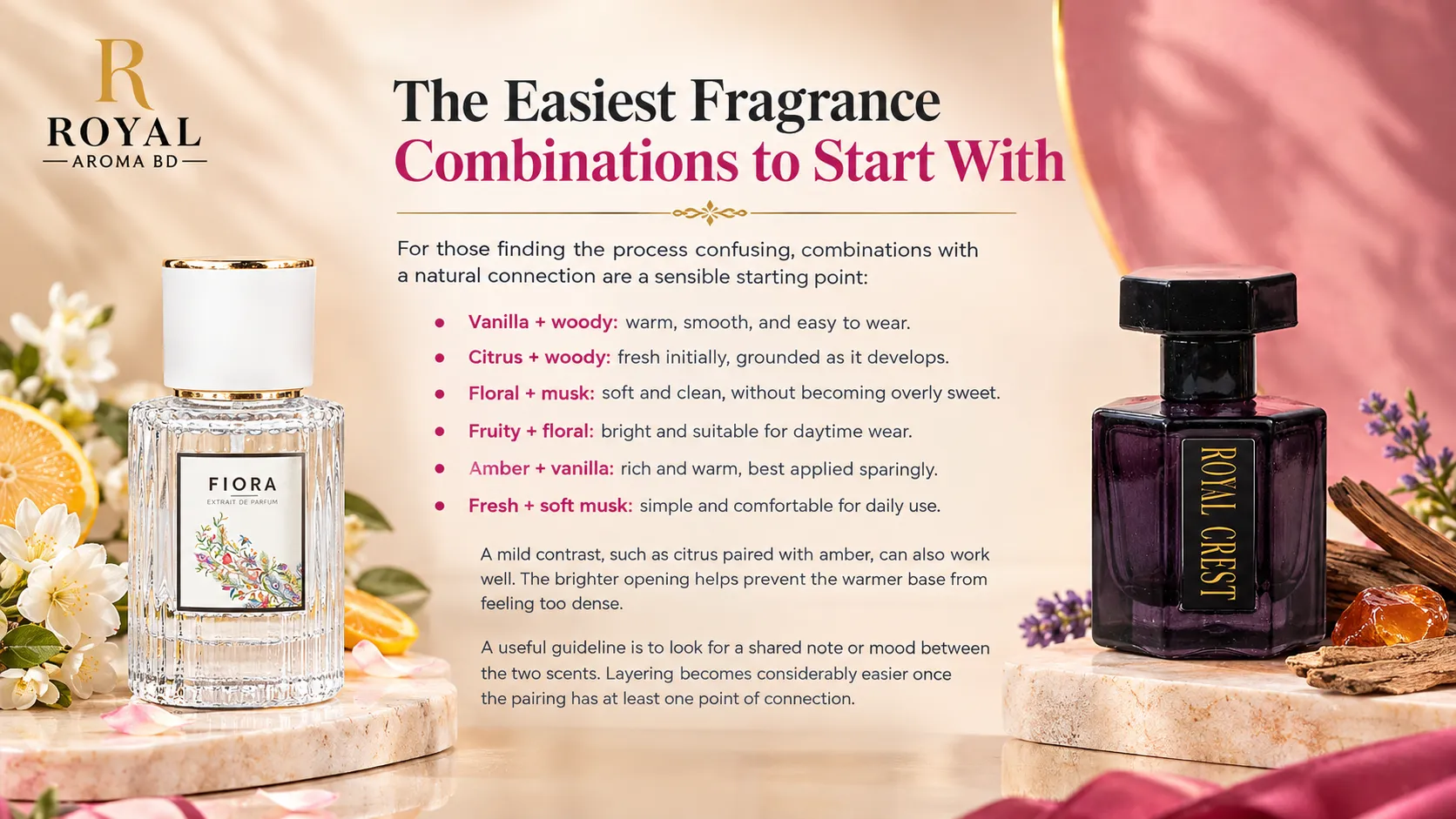
For those finding the process confusing, combinations with a natural connection are a sensible starting point:
A mild contrast, such as citrus paired with amber, can also work well. The brighter opening helps prevent the warmer base from feeling too dense.
A useful guideline is to look for a shared note or mood between the two scents. Layering becomes considerably easier once the pairing has at least one point of connection.
Application should begin on clean skin. If the skin is dry, an unscented moisturizer beforehand is advisable. Harper’s Bazaar’s expert perfume application guide notes that hydrated skin retains fragrance more effectively and recommends applying scent directly to pulse points.
The process itself can remain straightforward:
Additional perfume should not be applied simply because the first minute feels underwhelming, as the scent often changes once the opening notes settle.
For those exploring designer-style scent profiles, Royal Aroma’s inspired perfume guide can help identify fragrance directions that may already appeal to individual preference.
There is no single layering order that suits every formula. A practical approach is to begin with the lighter or fresher scent and add the deeper fragrance afterward. Citrus may precede woods, a body mist may precede perfume, and a soft floral may sit beneath amber.
Some fragrance experts prefer applying the heavier scent first, so it functions as a base. Both approaches can be effective, as formulas behave differently depending on the individual’s skin.
Testing the same pairing in both orders across separate days, while keeping the number of sprays consistent, allows one to determine whether the order genuinely affects the outcome rather than relying on assumption.
Solid perfume can also serve as a close-to-skin base or a subtle touch-up layer when reduced projection is preferred.
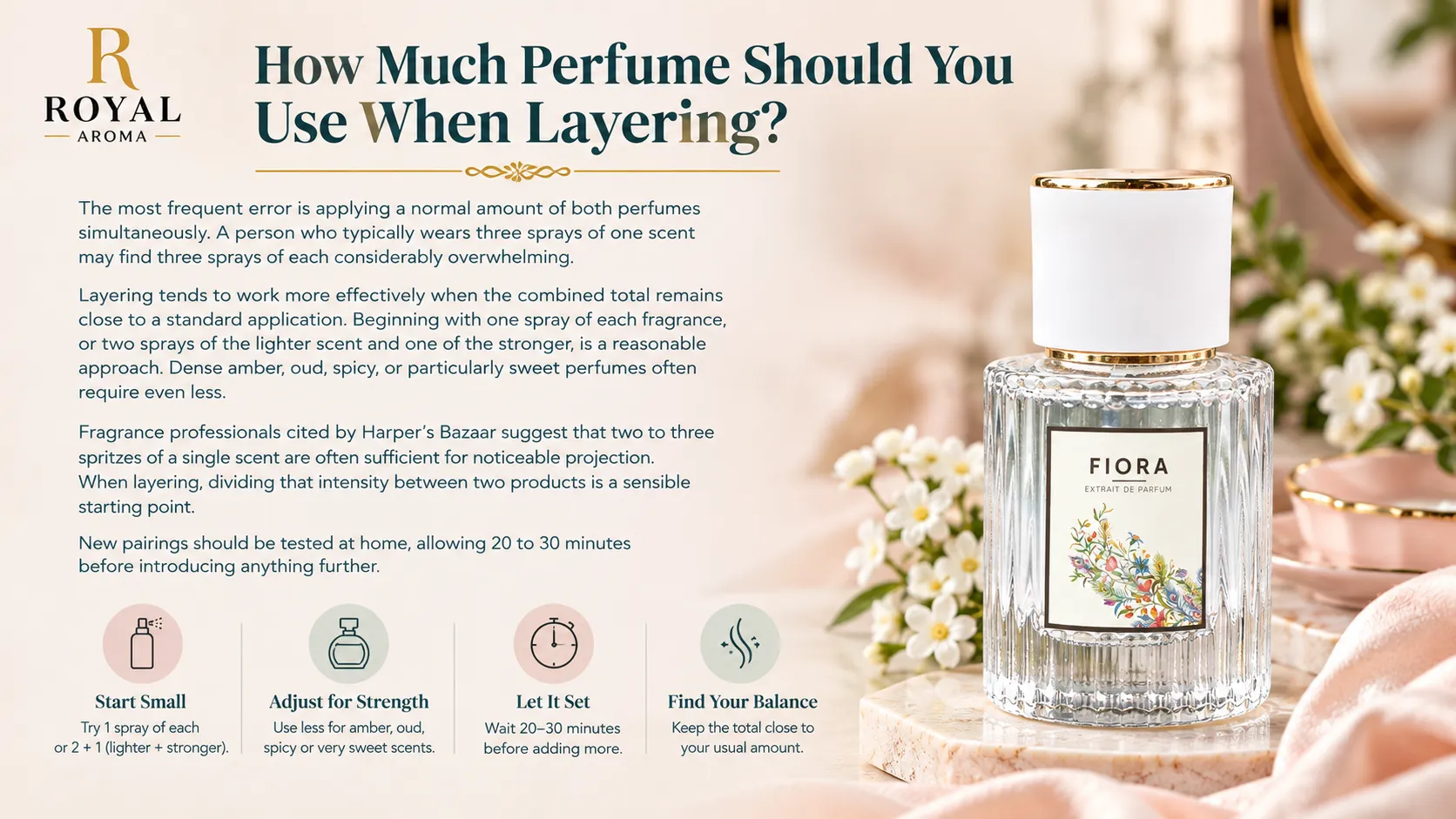
The most frequent error is applying a normal amount of both perfumes simultaneously. A person who typically wears three sprays of one scent may find three sprays of each considerably overwhelming.
Layering tends to work more effectively when the combined total remains close to a standard application. Beginning with one spray of each fragrance, or two sprays of the lighter scent and one of the stronger, is a reasonable approach. Dense amber, oud, spicy, or particularly sweet perfumes often require even less.
Fragrance professionals cited by Harper’s Bazaar suggest that two to three spritzes of a single scent are often sufficient for noticeable projection. When layering, dividing that intensity between two products is a sensible starting point.
New pairings should be tested at home, allowing 20 to 30 minutes before introducing anything further.
Layering typically goes wrong when too many elements are introduced at once. The following mistakes are worth avoiding:
Skin comfort is also worth considering. Cleveland Clinic’s guidance on fragrance reactions explains that fragrances can trigger contact dermatitis in some individuals and recommends testing unfamiliar products on a small area first. Itching, redness, or irritation should be treated as a reason to discontinue use.
Several expensive full-size bottles are not required to learn layering effectively. Beginning with one well-known scent and adding something that alters a single aspect, such as freshness, sweetness, musk, or warmth, is generally sufficient.
This is where Royal Aroma BD fits naturally into the process of learning to layer fragrances. The current catalog spans several inspired profiles across citrus, woody, amber, spicy, and sweeter directions, which makes side-by-side comparison considerably easier without treating each trial as a significant purchase.
For those interested in masculine profiles, Royal Aroma’s guide to the best perfume for men in Bangladesh provides useful context on fresh, woody, and heavier scent styles.
The objective is not to accumulate more bottles, but to determine what genuinely appeals to one’s own sense of smell.
A simple formula can make the process considerably less arbitrary:
Main scent + supporting scent + one small adjustment
If the main perfume is woody, a small addition of vanilla can provide warmth, or citrus can add brightness. If the main scent is floral, clean musk can introduce softness. If the scent is particularly sweet, a dry woody or fresh note can prevent it from feeling excessive.
Recording combinations that work is worthwhile. A note such as “2 sprays citrus + 1 spray woody” is generally sufficient detail. The order should also be recorded if it made a noticeable difference.
This habit saves time and prevents multiple variables from being altered simultaneously. Layering becomes considerably more predictable when a single variable is adjusted, the combination is worn for several hours, and adjustments are made accordingly afterward.

Introduction: Explore the World of Inspired Perfume

Introduction Scent has a special ability to

Introduction Fragrance is highly personal; it has

Introduction At RoyalAromaBD, we bring the seduction


