
Royal Aroma BD: Bangladeshi Inspired Perfume
Introduction: Explore the World of Inspired Perfume


Projection describes how far a fragrance can be noticed around you at a particular moment. Sillage describes the scent trail you leave in the air as you move. Understanding perfume projection vs sillage helps you judge how a fragrance behaves, rather than relying only on how strong it smells immediately after spraying.
Longevity answers a different question: how long does the fragrance remain detectable? A perfume can last for hours close to your skin without filling the space around you. For inspired perfume buyers, separating these qualities makes product descriptions and personal testing more useful.
Think of projection as a fragrance’s noticeable reach and sillage as its trail. Both involve scent travelling through the air, so they overlap. However, they describe different observations.
Feature | Projection | Sillage |
Main question | How far away can someone notice it around you? | Can someone notice the trail you leave? |
Simple example | Someone notices your fragrance while talking to you | Someone notices your fragrance after you walk past |
What affects the observation? | Time, application, surroundings and perception | Movement, airflow, application and perception |
Neither term has a universal consumer rating system. One reviewer’s “strong” may be another person’s “moderate.” Useful descriptions explain the circumstances behind the rating.
Projection is the reach of a fragrance around its wearer at a given time. It can change throughout the wearing period. An opening that feels noticeable across a small space may become much softer later.
Descriptions such as “close to the skin” or “noticeable at conversational distance” can help, but they are informal observations. They do not describe a fixed circle around your body.
When comparing perfume projection vs sillage, remember that projection also exists while you move. Standing still simply makes it easier to observe reach without adding movement as another variable.
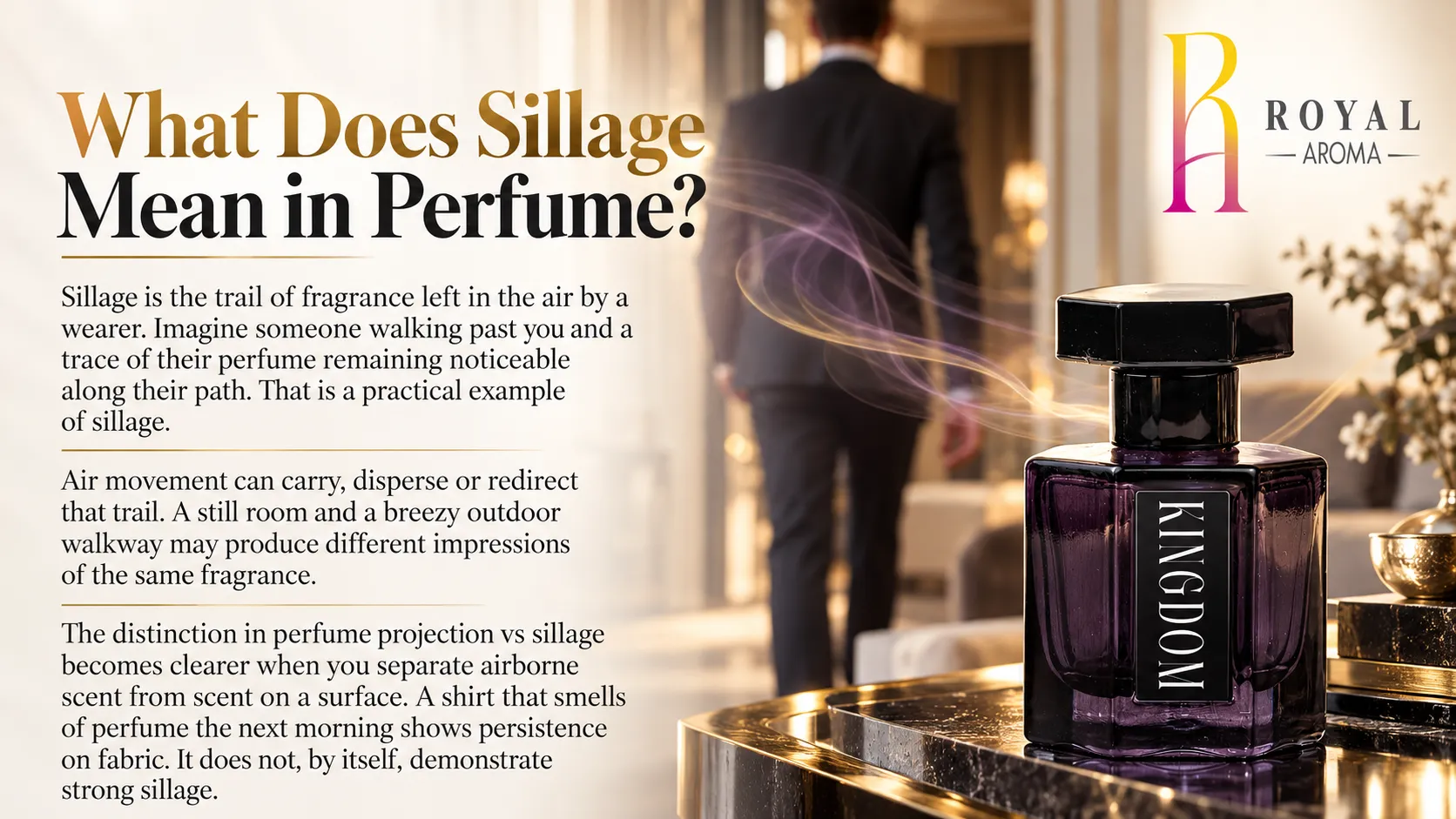
Sillage is the trail of fragrance left in the air by a wearer. Imagine someone walking past you and a trace of their perfume remaining noticeable along their path. That is a practical example of sillage.
Air movement can carry, disperse or redirect that trail. A still room and a breezy outdoor walkway may produce different impressions of the same fragrance.
The distinction in perfume projection vs sillage becomes clearer when you separate airborne scent from scent on a surface. A shirt that smells of perfume the next morning shows persistence on fabric. It does not, by itself, demonstrate strong sillage.
Longevity describes duration, rather than distance or trail. A perfume may become difficult to notice from a distance while remaining detectable close to the application area.
Performance quality | What you are assessing |
Projection | Noticeable reach at a particular time |
Sillage | The airborne trail associated with the wearer |
Longevity | How long the fragrance remains detectable |
This is why perfume projection vs sillage should not be judged from an “eight-hour lasting” claim alone. That statement does not explain how the fragrance behaved during those hours.
For application and storage advice, Royal Aroma BD’s tips for making perfume last longer cover the related topic in more detail.
Application amount, formulation, skin properties, elapsed time and surroundings can all influence your experience. A fragrance tested beside a fan may behave differently from the same fragrance in a quieter indoor space.
Published research on fragrance evaporation and skin properties examined fragrance molecules on ten volunteers. It explored how molecular characteristics and skin properties contribute to differences in evaporation. It was not a performance test of Royal Aroma BD products.
For a useful perfume projection vs sillage comparison, record your conditions. In Bangladesh, an air-conditioned office and an outdoor commute are different settings. Avoid assuming humidity always produces one predictable result.
Concentration alone is also insufficient. A higher fragrance-oil percentage does not automatically guarantee greater reach or a more noticeable trail.
A simple comparison can help you understand your own perfume. You need a timer, a short notes sheet and a willing helper. These are practical observations, not laboratory measurements.
Test one fragrance at a time and record the application area and spray count. Ask your helper whether they can notice it from the same positions at each checkpoint.
Try checking after 15 minutes, one hour and three hours. These are convenient observation times, not official performance standards. Avoid spraying again during the test.
Walk past your helper at a comfortable, consistent distance. Ask whether they notice a trail after you pass. Avoid rooms already filled with perfume, incense or cooking smells.
For a fairer perfume projection vs sillage assessment, repeat the comparison on another day under similar conditions. Equal spray counts are only approximate because different pumps can dispense different amounts.
Time | Surroundings | Projection observation | Trail observation |
15 minutes | Record airflow and location | What could the helper notice? | Was a trail noticeable? |
1 hour | Note any changes | Repeat from the same positions | Repeat the walk-past check |
3 hours | Note any changes | Record reduced or remaining reach | Record the remaining trail |
Repeated exposure can reduce your sensitivity to a particular smell. This helps explain why a fragrance may become less noticeable to you while another person still detects it.
Research on olfactory adaptation describes reduced sensitivity following repeated or prolonged exposure to an odour. However, actual fading can happen too. Not noticing your perfume does not establish which explanation applies.
When testing perfume projection vs sillage, another person’s observations can therefore be useful. Avoid adding more sprays automatically because you cannot smell yourself. Check first, especially in shared spaces.
The most noticeable perfume is not automatically the most suitable. Your surroundings and the people sharing them matter.
Setting | What to consider |
Office or classroom | Whether nearby people can share the space comfortably |
Crowded transport | Close proximity and limited ability to move away |
Outdoor gathering | Airflow and changing distances between people |
Evening social occasion | Venue size, seating and personal preference |
Use perfume projection vs sillage as a way to match performance to the occasion. A restrained fragrance can suit close conversation, while a more noticeable presence may fit some spacious settings.
Follow any fragrance-free rules. There is no single spray count that works for every formulation, pump and environment.
An inspired perfume takes a recognised fragrance profile as a reference. That does not guarantee an identical formula, projection pattern, scent trail or wearing time.
For example, Thunder, Royal Aroma BD’s Sauvage-inspired perfume, is listed with bergamot, pepper, aromatic notes and an ambroxan-based dry-down. Those details help describe its intended scent profile. They do not establish a measured projection distance.
When assessing perfume projection vs sillage in an inspired fragrance, test the actual product you plan to wear. A review of the designer reference cannot substitute for that experience.
Look for feedback that mentions application, elapsed time and surroundings. “Noticeable during a conversation after one hour” is more informative than an unexplained claim that something is “beast mode.”

Introduction: Explore the World of Inspired Perfume

Introduction Scent has a special ability to

Introduction Fragrance is highly personal; it has

Introduction At RoyalAromaBD, we bring the seduction


